Showing posts with label reading. Show all posts

Sunday, November 6, 2016

Phonics Focus: Sh and Ch

Our phonics-focus this week is consonant digraphs. 

We are learning the "sh" and "ch" sounds (as in the images below). ("Th" and "wh" are coming up next.)

The sh sound:


The ch sound:


Videos that teach this skill:
The Ch Sound: https://www.youtube.com/watch?v=VcDo7dczpRA

The Sh Sound: https://www.youtube.com/watch?v=ptfu3tL0OBg


Online Games that teach this skill:
 Sh on Starfall

Ch on Starfall


Download Free Activities Safely here:
https://www.teacherspayteachers.com/FreeDownload/Phonemic-Awareness-Initial-Sounds-Digraphs-sh-and-ch

Friday, October 14, 2016

Reading Strategy of the Week: Stretchy Snake

Our Reading Strategy of the week for the October 17 - 21 Newsletter is Stretchy Snake.

Help your child to stretch out words to hear every sound. This will help them with spelling too. We want them to hear the beginning, middle, and ending sounds in words.

Here is a video example:

Tuesday, October 11, 2016

Writing: Non-Fiction

Next week, students will begin learning to write their own non-fiction, informative texts.Students will learn to write informational texts that teach others interesting and important information and ideas about a topic.

You can help your child with this by reading non-fiction books at home. This will help familiarize your child with the organization of non-fiction, informative texts, and help them learn about topics they may want to write about. They will feel more confident about coming up with ideas to write about, and having ideas they want to share and communicate to the world. Let your child have fun and get excited for choosing books about topics that really interest them. Engage their natural curiosity and wonder.


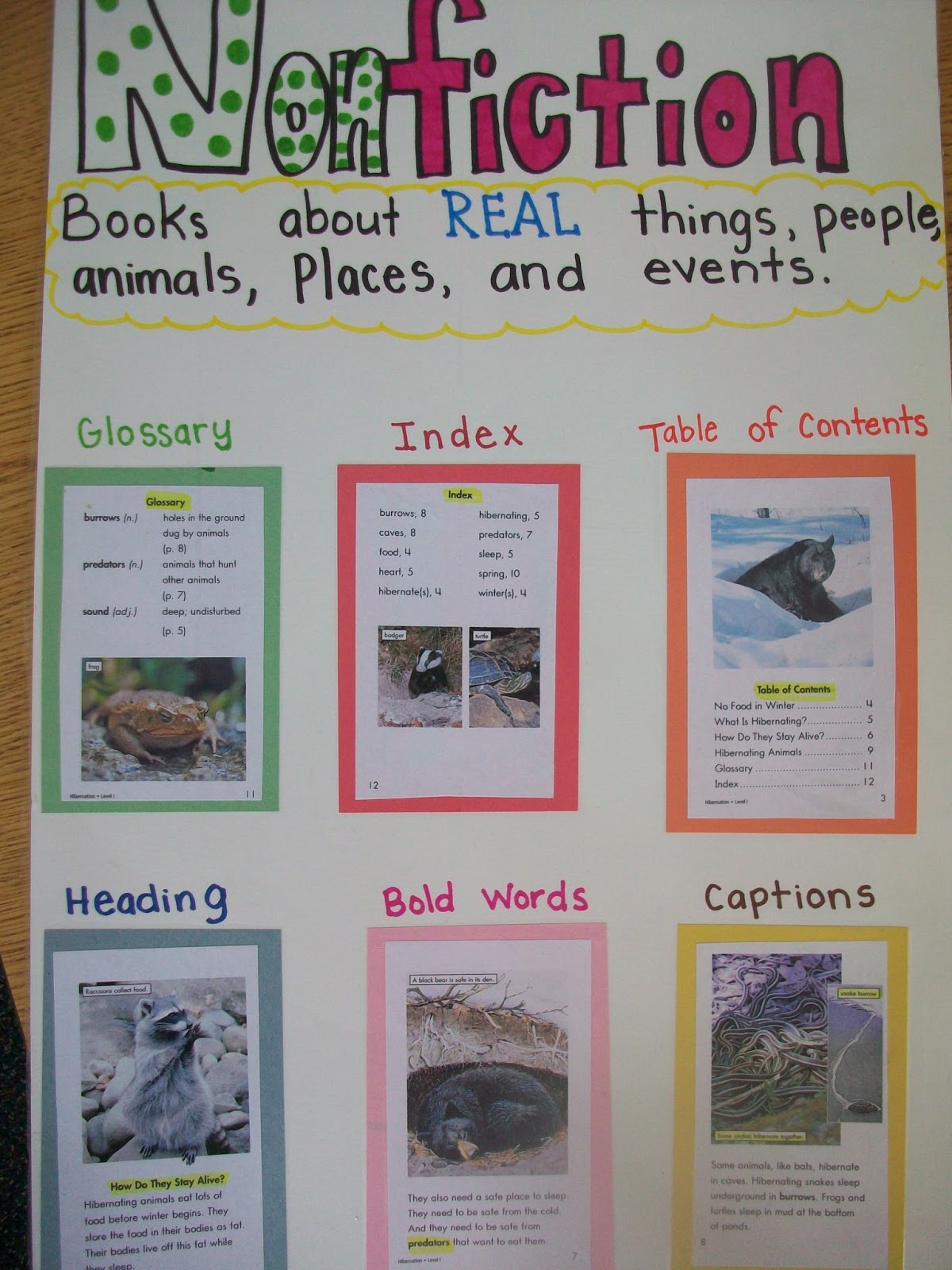
Try and choose books that include a table of contents, a glossary, bold words, pictures, and diagrams.

National Geographic offers great options. We would love some donations to use in our class, too! :) If you  need help choosing a good level for your child, please read my post on choosing good-fit books, or email me.


Questions you can ask your child:
- Ask your child to use the table of contents to find information in the book. 
- Ask them to use the glossary to learn what new words mean. 
- Ask them why some words are bold. 
- Ask your child why they think the author wrote this book.
- Ask them to explain what a diagram is teaching them. 
- Ask them what they know about a topic, prior to reading a book, what they wonder, or have questions about the topic, and what they learned after reading it. This is also called a "KWL" chart (see example below. Your child is familiar with this way of thinking.


Help your child to notice facts, and even jot down notes about their favorite facts, or their opinions on what they have read.


This is the Kindergarten checklist for informative writing, from which we are growing from.

Students are also learning to re-read what they write, pointing to the words as they go. We want them to notice when something doesn't make sense. We want them to capitalize the beginning of sentences, and use appropriate punctuation at the end of sentences. We want them to spell words to the best of their abilities, saying a word out loud and stretching it out to hear each sound in the word. We want them to use their word wall, or a dictionary as a resource for looking up and spelling words. I highly suggest getting a picture dictionary for your child to use at home.


You can read more about non-fiction text features on my post about Making and Confirming Predictions.

Learning Videos for Kids:
What is Editing?

Wednesday, October 5, 2016

Reading: Poetry

We are learning all about poetry

Read poetry often. This will develop your child's eye and ear for poetry. We want them to understand what poetry is, why people write it, and how to create it themselves.

Questions to Ask:

- What do you notice about this poem? Do you see a pattern?

- Why do you think the author wrote this poem?

- Do you like this poem? Why or why not?

- Would you like to write a poem like this?


Reading Poetry Strategies:

- Visualize the poem. See it in your mind like a movie. 

- Reread the poem to make it smoother and understand it better.

- Read the poem out loud with expression to develop fluency and for fun.


Use poetry vocabulary, such as alliteration, rhythmrhyme, and repetition.


Wednesday, September 28, 2016

Choosing Good Fit Books

When a student reads a book by his or herself, it needs to be a good fit- just right for his or her reading level. 

Use the strategy below to help you and your child learn how to choose good fit books. 

Also, please note that if you are reading a book to your child, you can choose a higher level book, and I encourage you to do so. Read a variety of books to your child for fun.

Reading Packets


Dear Parents,


I am so excited to begin sending home reading packets. These packets will include sight words, a leveled book, reading strategy work, and a reading log, as well as other activities specifically made for your child. Each child will have different materials sent home in their manilla folder. This is their reading packet.

Please have your child bring this packet with everything in it to school every day.

We will use these in class, and they will be given new books to take home.

If a book is lost, you will be responsible for paying for a new book. Please help your child to take care of their materials, and keep their books safe.

I suggest that your child reads his or her book each day, or for 10-20 minutes. I also suggest that your child practices reading and writing the sight words given to them. Their words are on a list in the packet, as well as on notecards.


Thank you for all you do,
Ms. Minnerick

Tuesday, September 27, 2016

Our Reading Strategies: Flippy Dolphin

Our class has read and discussed the book, The Little Engine that Could by Watty Piper. (I highly recommend getting a copy to read aloud to your child over and over.)

The Little Engine is an example of not giving up, and the power of believing in ourselves. Students know not to give up when it comes to reading a word. They know that good readers have good habits, also called Reading Strategies, for solving hard words. They know to stay positive. They tell themselves, "I Think I can. I think I can." They try their strategies for solving hard words.They really can do it! They have strategies! Encourage your child when they get to a tricky part, and say, "I think you can!"


Be patient, and always, keep reading fun! 


One of our reading strategies that we use when reading a book  is called "Flippy Dolphin." It's also called "Try it 2 Ways."


This strategy helps us to figure out how to read a tricky or hard word, by trying saying the sound of a vowel in a different way. One sound is called a short vowel, the other is called a long vowel. 


For example, in "cane" and "can" the vowel sound "a" is pronounced in different ways. So if a student was reading  a book and the sentence said, "The man with the hurt foot was using his cane to walk", but your child reads it as, "The man with the hurt foot was using his can to walk", we want your child to ask himself, "Does it make sense?", and if not, try saying the vowel sound, or other "chunks" (see our Chunky Monkey Reading Strategy, and see image below) in a different way. 


You can download and print this document for FREE at Teachers Pay Teachers. I highly encourage you to make an account so that you can download all the resources I share on this website. It's simple and free, and oh so helpful for our kiddos!

Watch this short video to see "Flippy the Dolphin" in action:

You can sing this song to the tune of "If You're Happy and You Know it", to help your child remember this strategy.
You can print this for free: Flippy Dolphin Song Sheet


We use Reading Strategies Bookmarks during independent reading time in class. This  help us to remember all the things we can try to figure out how to read a tricky word. I plan on sending each child home with a Reading Strategies bookmark. 

You can learn all about the strategies and download free Reading Strategy Bookmarks here: Reading Strategies Posters and Bookmarks, By Growing Firsties


Monday, September 12, 2016

Reading: Making and Confirming Predictions

In Reading, we have been learning that readers have good habits. Things they do without having to be reminded to do them. One of those good habits is making predictions. Good readers predict what the book they have is going to be about by looking at clues such as the title and pictures. Last week, we learned how to make predictions before and while reading fiction books. This week, we are learning to make and confirm predictions while reading Non-Fiction texts.


Making and Confirming Predictions in Non-Fiction Texts


Essential Questions/Question Stems:
*The reader can tell that __ (prediction stated) because – 
*The reader can tell that __ (prediction not stated) because –
*How can/did my prediction help me understand what I am reading?
*How can I make predictions while reading?
*What parts of a nonfiction book can help us to make predictions?


At Home Practice: 
Choose a non-fiction book that peaks your child's interest, and is on their reading level. 
List of Non-Fiction Books:
http://commoncore.scholastic.com/teachers/books/non-fiction


Explain that one characteristic of informational books is that they have nonfiction text features. Use a nonfiction book to briefly go over some of the nonfiction text features: headings, photographs, table of contents, diagrams, labels, etc. For this activity to be effective, the text needs to have plenty of text features for the reader to use. Example: Read a bold heading and use the information in the heading to make a prediction about what a page/section will be about. Provide your child with a variety of non-fiction, good-fit books for them to practice making and confirming predictions while doing independent reading.


Answer: Labels

Videos for Kids:
Fiction Vs. Nonfiction: